
1
Escape the Algorithm
Escape the Algorithm
Inhoud
Who is really in control of what we believe? The performance mirrors the mechanics of fake news: unseen forces shaping visible behavior, blurring the line between autonomy and manipulation. Just as the threads remain barely noticeable, misinformation often operates beneath awareness, guiding perceptions and reactions. The flash mob (performed by dance school Nataraj) invites us to question what is real, who is in control, and how easily narratives can be constructed—and believed.

Fake news spreads faster than ever in a world where almost everyone uses social media daily — and most people encounter misinformation online without even realizing it. But while fake news feels like a modern problem, manipulation through rumors and emotional stories has existed for centuries, even in ancient Rome.
PART 1 — THE HOOK
Would You Fall For This?
Every day, we scroll through hundreds of headlines, videos, posts, and memes — often reacting before we even think. Fake news knows exactly how to capture attention using shock, humor, fear, and curiosity. But how easy is it to manipulate our emotions online? In this activity, you’ll test yourself with viral-style fake headlines and discover how quickly our brains react before checking the facts.
Read some titles below:
- “Netflix Testing ‘Skip Homework’ Button for Students”
- “Scientists Say 3 Days Without TikTok Improves Brain Function”
- “Cats Officially Recognized as Emotional Support Managers”
- “Government Considering Tax on Voice Messages Longer Than 1 Minute”
- “Influencer Accidentally Uses Beauty Filter During Police Interview”
- “New Study Finds People Read Only Headlines Before Arguing Online”
- “AI Predicts Your Next Breakup From Spotify Playlist”
- “University Allows Students to Pay Tuition With Memes”
- “Smartphones May Soon Detect Lies During Texting”
- “Researchers Discover Plants Grow Faster When Exposed to Drama”
Now take time and share with us your answers below under task 1a:
- Which headline made you react emotionally?
- Which one would you click first?
- Which one feels believable even if it sounds strange?
- Which one would spread fastest online?
- Did you react before checking if it was true?
- What emotion was the headline trying to trigger?
Take a look at these two headlines:

Now go to Task 1B and write down your answer. Explain why you believe the option you selected is correct by providing your reasoning.
PART 2 — WHY FAKE NEWS SPREADS
Your Emotions Are the Target
How does a fact become a misconception? Dig into the world of misinformation to see how facts can become distorted and misleading.
Fake news doesn’t spread because it is true — it spreads because it makes people FEEL something. Anger, fear, excitement, outrage, and curiosity are powerful emotions that drive clicks, comments, and shares. Social media algorithms reward emotional reactions, which means the most dramatic content often spreads the fastest. In this activity, you’ll explore how emotions are used to manipulate online behavior and why humans are especially vulnerable to emotional content.

3 Steps to Identify and Contain Emotional Manipulation
- Pause. Look away from the screen, headline, or post for a moment before reacting. Fake news is designed to trigger instant emotions and impulsive sharing, so taking even a few seconds to pause helps your brain switch from emotional reaction to critical thinking.
- Ask Yourself: “What Am I Feeling?” Notice your emotional reaction. Does the content make you angry, afraid, shocked, excited, or outraged? Emotional manipulation works best when people react automatically without questioning why they feel that way.
- Name the Feeling Precisely. Try to identify the exact emotion you are experiencing. Instead of saying “This makes me feel bad,” be specific:
- “I feel angry.”
- “I feel anxious.”
- “I feel shocked.”
- “I feel curious.”
Naming emotions helps reduce impulsive reactions and makes it easier to recognize when content may be trying to manipulate you emotionally rather than inform you with facts.
Let’s put what we’ve learned into practice. Open this puzzle and match the fake headlines below with the emotions they are designed to trigger.
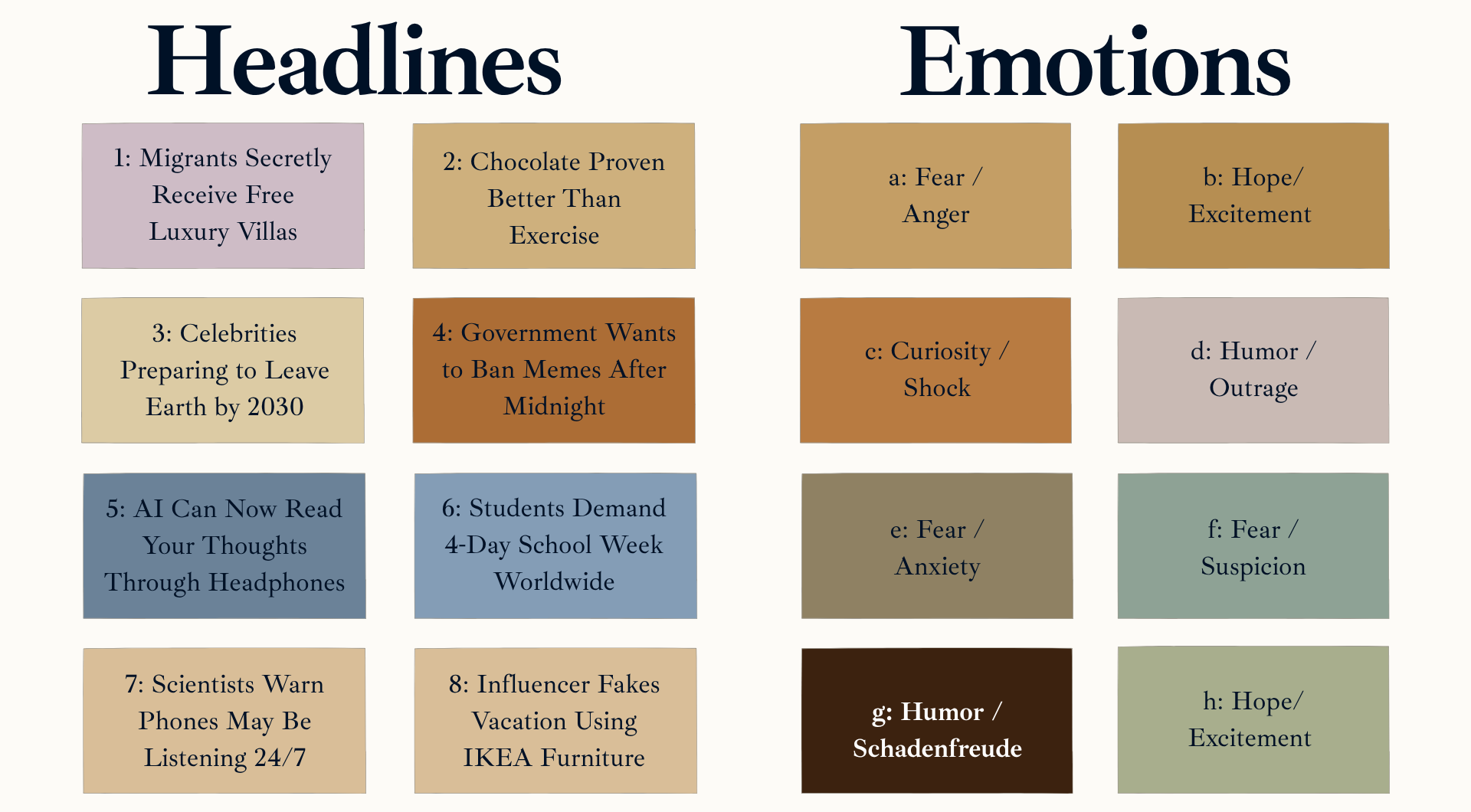
Why Algorithms Love Emotions
Social media platforms are designed to keep users online for as long as possible. Algorithms often promote content that creates strong emotional reactions because emotional posts get more clicks, comments, and shares.
Have you noticed how one click changes your feed?
Watch this video to learn more about algorithm:
Ontvang een activiteitenbadge
Algorithm Survivor Behaal deze badge
Congratulations! You have successfully completed the “Escape the Algorithm” learning activity and strengthened your media literacy and critical thinking skills.
By earning this badge, you demonstrated the ability to:
- recognize emotional manipulation in online content,
- identify common fake news techniques,
- analyze headlines critically,
- question sources and online narratives,
- and apply practical strategies to uncover misinformation before sharing it.
You explored how emotions such as fear, outrage, humor, and curiosity influence online behavior and learned how fake news spreads through social media and digital platforms.
As a Fake News Detective, you are now better prepared to navigate the digital world responsibly, think before reacting, and make informed decisions online.
Om deze badge te verdienen dien je 1 taak te voltooien
Taken
Taak nr.1
Bewijs bevestigd door: één activiteitenorganisator
Task 1a. Would You Fall For This?
Read some titles below:
- “Netflix Testing ‘Skip Homework’ Button for Students”
- “Scientists Say 3 Days Without TikTok Improves Brain Function”
- “Cats Officially Recognized as Emotional Support Managers”
- “Government Considering Tax on Voice Messages Longer Than 1 Minute”
- “Influencer Accidentally Uses Beauty Filter During Police Interview”
- “New Study Finds People Read Only Headlines Before Arguing Online”
- “AI Predicts Your Next Breakup From Spotify Playlist”
- “University Allows Students to Pay Tuition With Memes”
- “Smartphones May Soon Detect Lies During Texting”
- “Researchers Discover Plants Grow Faster When Exposed to Drama”
Now take time and share with us your answers to below questions:
- Which headline made you react emotionally?
- Which one would you click first?
- Which one feels believable even if it sounds strange?
- Which one would spread fastest online?
- Did you react before checking if it was true?
- What emotion was the headline trying to trigger?
Task 1b. Would You Fall For This?
Take a look at these two headlines:

Write down your answer. Explain why you believe the option you selected is correct by providing your reasoning.
Taak nr.2
Bewijs bevestigd door: één activiteitenorganisator
Task 2. Your Emotions Are the Target
Ask yourself:
- Is this headline trying to make me angry?
- Is it designed to shock or scare me?
- Does it create excitement or curiosity?
- Why would people feel tempted to share it?
Share your answers with us.
Taak nr.3
Bewijs bevestigd door: één activiteitenorganisator
Task 3. Train the Algorithm (not mandatory)
Choose several posts you would normally click on while using social media. Over the next few days, observe how your feed changes based on your interactions, then come back and share your observations.
Did you notice any patterns like:
- click emotional post → more emotional content appears
- click conspiracy → similar content increases
- engage with outrage → outrage dominates feed
Are you choosing your content — or is the algorithm slowly choosing it for you?
Organisatoren
TiPovej!
Badge-uitgever erkend met
Gebruikt in playlists
Truth or Trap?
TiPovej!Gemaakt op Ljubljana City of Learning

Awero host dit platform en ontwikkelt het samen met toonaangevende educatieve organisaties. Het programma Erasmus+ van de Europese Unie heeft cofinanciering verleend voor de bouw van de eerste versie van dit platform. Neem contact op met support@awero.org.
Wijzigen in een andere taal: